| Subcribe via RSS

Gmail Contact Importer

April 6th, 2011 | No Comments | Posted in API, PHP, Programming, XML

Import your Gmail Contacts the fast and easy way (insert Billy Mays voice here)

My overall objective was to build very simple API that would allow a user to download his/her Gmail contacts and display them in a specific format.

In my opinion a API like this should be very popular amongst the social networking sites.

The API has the capability to be configured to show results in several different formats XML, JSON, and PHP format. The PHP format returns the results in an array format.

The operating format is as follows.

  • Source:contacts
  • Gmail:Username
  • Gmail:Password
  • Format:PHP, or XML, or JSON

http://apime.josephtinsley.com/contacts/{user_name}:{user_password}/{format}

http://apime.josephtinsley.com/contacts/bob:I_luv_Tacos/json

A simple way of including the result set into your PHP web page is to use PHP’s file_get_contents function.

1
2
3
4
5
6
7
8
<?PHP

$results = file_get_contents('http://apime.josephtinsley.com/contacts/{Email_Address}:{Password}/{Format}');
print '<pre>';
print_r($results);
print '<pre>';

?>

*results are limited to 25 contacts right now*
Thanks,
Joe

Google’s Analytics API with PHP

April 5th, 2011 | No Comments | Posted in API, Google, PHP, Programming, SEO

I was recently asked about my experience with Google’s Analytics API, my reply was bla, bla, bla, I do not have any experience with their API’s.  But to be honest I couldn’t remember why at that moment I didn’t. I think the only reason was because of their documentation, for some of their API’s it’s a pretty long, difficult read. But overall that wasn’t a very good reason, so I decided to take some time and dive in and whoop that trick (line from the hustle and flow movie).
The goal for this post to help anyone who may be having a hard time understanding how to build a connection to Google’s Analytics API.
So first there are a couple of things you need to know.

There are only two files needed in this script but the connection part is the only part we will be going over, it’s in the gaClass.php file.
So basically I’m still new to  Google’s Analytics API but what I’ve learned so far is that once you’ve established a connection the rest is pretty simple.  So basically that’s why we will be focusing on the establishing a connection part only.

Your first major goal while trying to establish a connection is to collect the authentication string. Within that string is your authentication token, and without that token you can’t get anywhere so remember that. The overall objective is to get the authentication token.

So open up the gaClass.php file and take a look at the construct method, this is where the connection happens. Please contact me if I confuse your somewhere, I try to code so that it’s easy to follow.

  • Within the construct method we start off by collection your email and password that was set on the form page. They of course are needed to connect to your account.
  • We set the url that we will be trying to making a connection to. In this case it’s the ClientLogin URL (https://www.google.com/accounts/ClientLogin) . Take note that the protocol starts with HTTPS.
  • Within our POST request we have a few additional parameters that will need to be pass along including your email and password. A short description of these parameters can be found at (http://code.google.com/apis/analytics/docs/gdata/gdataAuthentication.html) scroll down until you see the HTTP Protocol Details heading
  • Now once we have all the parameters set we will try to actually make the connection. We do this within the next method. The curlConnection method, and it does exactly what it says, tries to makes the connection via cURL
  • The curlConnection method will take the parameters we talked about earlier and send them to the ClientLogin URL via cURL using a POST method. The answer we receive from this post will or will not include our authentication token.
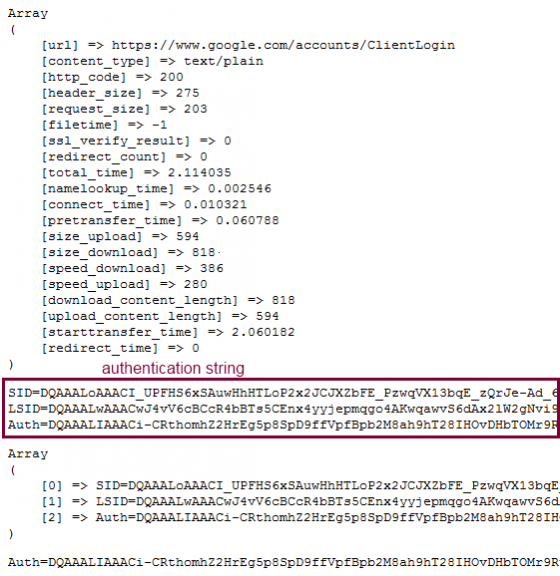
  • Now let’s suppose it does and the header status code equal 200, which means it’s A-OK. Within that connection response output you will see a encrypted string. But look closers you’ll see three variables with three values assigned to it. The variables are labeled , “SID”, “LSID” and  “AUTH”. Well you want the AUTH and it value.  Our next task is to parse out the AUTH variable and its value, and we do this with the setAccessToken method.
  • The setAccessToken is fairly simple we take that string and convert it to an array using PHP’s built in explode function.  The access token should be in the second element. I then assign this value to a token variable to be used later for accessing other parts of the API. If you recall when we started this post the authentication token is essential to other parts of the API. Without it you basically can’t do anything.

So that you can get a idea of what the output data look like.  I’ve included a screen shot of the header response output, the authentication output, when the authentication output is converted into a array, and the authentication token.
Googles Analytics API Header Response


I’m new to Mercurial so please don’t give me a hard time about my commits or the lack of.
https://bitbucket.org/josephtinsley/google-analytics-api/overview

Google Analytics API with PHP


Reverse IP Look up .V2

January 26th, 2011 | No Comments | Posted in API, PHP, Programming, SEO

I’ve updated my Reverse IP Look up script. This script/tool will attempt to display a list of domain names that are hosted on the same IP address.

My original script was a bit slow, this one should display results a lot  faster. I’ve also add a simple API that can be configure to show results in different formats XML, JSON, and PHP format. The PHP format returns the results in an array format.

The GUI interface is located in the SEO tools section of this site Reverse IP Look up

To access the API, use the URL below.

Just include your domain name where the curly brackets are, then pick a format to display the results in.

Example

http://apime.josephtinsley.com/{domain_name}/php/

http://apime.josephtinsley.com/bk.com/php/

Thanks,

Joseph

== UPDATED APRIL 06, 2011 ==
In the near future I plan to add more API’s
To handle this change you are now required to add the API’s source that you want to use.
The Reverse IP Look Up source is “reverse

So or example
Instead of

http://apime.josephtinsley.com/{domain_name}/php/

It will need to be

http://apime.josephtinsley.com{source}/{domain_name}/php/

so

http://apime.josephtinsley.com/reverse/bk.com/php/

would be the finished URL.

Thanks again,
Joe

Make Twitter Updates with PHP and cURL

June 18th, 2010 | No Comments | Posted in API, PHP, Programming

I’m sure I’ve mentioned sometime before that I’m a big fan of Twitter. I think Twitter has done a great job with their API, and the documentation for their API. They’ve made it fairly simple for developers to create Twitter based applications without jumping through a lot of hoops.

Well below is a bit of code I’ve used in the past to make status updates to Twitter. If your familiar with cURL then you’ll see that its pretty straight forward. The end result examines the HTTP code to determine if the status update was successful or failed you can comment this part out if you wish.

But before you go plowing away with the code I think it would be a good idea if you make yourself familiar with their documentation. They have a few rules that could save you some heartache down the road.

== Twitter Documentation ==
http://apiwiki.twitter.com/Twitter-API-Documentation

== PHP Code To Post Twitter Status Updates ==

1
2
3
4
5
6
7
8
9
10
11
12
13
14
15
16
17
18
19
20
21
22
23
24
25
26
27
28
29
30
31
32
33
34
35
36
37
38
39
40
41
42
43
44
45
46
47
<?PHP

/* Post Twitter Status Update using PHP & cURL */

function postToTwitter($username,$password,$message){
 
   $username = $username;
   $password = $password;
   $twitterHost = "http://twitter.com/statuses/update.xml";
   $yourStatus = $message;
   $curl;
   
   $curl = curl_init();
   curl_setopt($curl, CURLOPT_CONNECTTIMEOUT, 2);
   curl_setopt($curl, CURLOPT_HEADER, false);
   curl_setopt($curl, CURLOPT_HTTPAUTH, CURLAUTH_BASIC);
   curl_setopt($curl, CURLOPT_RETURNTRANSFER, 1);
   curl_setopt($curl, CURLOPT_USERPWD, "$username:$password");
   curl_setopt($curl, CURLOPT_HTTP_VERSION, CURL_HTTP_VERSION_1_1);
   curl_setopt($curl, CURLOPT_POSTFIELDS, "status=". urlencode(stripslashes(urldecode($yourStatus))));
   curl_setopt($curl, CURLOPT_URL, $twitterHost);
   
   $result = curl_exec($curl);
   $resultArray = curl_getinfo($curl);
   
   if ($resultArray['http_code'] == 200) {
   
   $twitterPostStatus = "Success";
   
   } else {
   
   $twitterPostStatus = "Failed";
   
   }
   curl_close($curl);
   
 return $twitterPostStatus;  
}

$username = 'username_here';
$password = 'password_here';
$message = "Working with the Twitter API";

$result = postToTwitter($username,$password,$message);

print_r($result);
?>
Tags: , ,

Twitter IPhone App – Custom API URL

May 21st, 2010 | No Comments | Posted in API, Programming

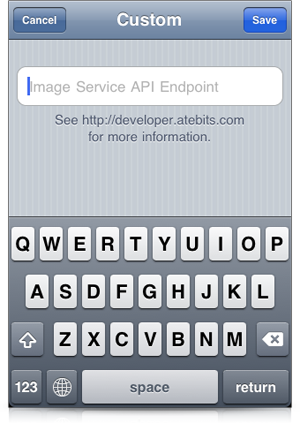
Change of plans. I decided to take an opportunity I came across yesterday.Custom API URL - Twitter IPhone App
Let me explain. I subscribe to Tech Crunch via twitter, that’s my way of keeping up with who’s, who’s and the what’s going on in the tech world. Well I saw a post they made yesterday about a new twitter IPhone application that was coming out or maybe it was just being renamed, I can’t remember but you get the idea, right?  So I thought why not give it a try. So I went to the Itunes App store via my IPhone and  downloaded the app. I played around with it for a while and quickly became very happy with the functionality. It had a butt load of options and was totally ad free. For the longest I had been using Echofon which wasn’t.
Any who, one of the features I played around with while testing was the photo posting. Photo posting is probably one of the most important feature for me. I figure I can text my posts in if needed.

So to test this feature out I added a test twitter account to the app and posted a random photo from my IPhone. The photo showed up immediately which is great, but when I took a closer look I realized it posted the image to Yfrog. WTF, I was kind of irritated for a little while and wonder why in the heck would they use that site, I hate that site. So I went back to the app to see if there where other options I could select from that would allow me to change this out. Echofon has that feature, so I assumed they would also. Now hold your hat on what I’m about to tell you next, it’s a shocker. Not only did they have several options to choose from, they also had an option that would allow you to add your own custom API URL. Yea that’s music to my ears. First off I love using API’s and secondly I just so happen to have a image hosting site that posts to Twitter and Facebook. So that was it, I knew my night was on lock. I took a pause for a few minutes and then went straight to Burger King and grabbed a couple of those $1.00 double cheeseburgers, came back to the house and started coding my ass off. I think I went to sleep around 4 am, but had to get back up by 9:00 am, I had some shares of stock that I was trying to dump before the market bottomed out.

So to make a long story short I completed building the API for my site sometime around 5 p.m. today. It took longer than what I expected because the market went running today. If you’re curious I took home an extra 315 bucks today. But I have everything working now. You can now post images to your Frin.ly account from Twitter’s IPhone app. I’m not advertising the API right now because I want to take sometime to revamp the site before I start to let people use it. I was looking at some of the code and some of it didn’t make since to me, and I was the person who wrote it. Go figure.

Anyway I said all of this to say that I’m off track right now and things will probably be pushed back another week or so I think. But I’ll keep you posted.
Later,
Joe

Tags: , ,

Geolocation by IP Address with PHP

January 5th, 2010 | No Comments | Posted in API, PHP, Resource

Something kind of interesting happened today. I was going through my log files and noticed a query for “joe Tinsley woodland park” the query originated from “Medford, Massachusetts”. Woodland Park was an elementary school located on an air force base in South Carolina that I attended when I was a kid. I take it that someone from my past is trying to locate me. That’s pretty cool. The crazy part is I just noticed that I don’t have anyway for anyone to contact me via my website… Ha! I make the craziest moves sometimes.
Well I’ve mentioned all of this to say If you’re looking for a way to pull Geolocation Data from a single IP address try IPpages.com’s APIs. I’ve been using them for some time now and the service is pretty good. It does require some programming knowledge to the extract the data from the XML results.
Please let me know if I can help with any programming questions (PHP only!).

Tags: , ,

Programmableweb, The Best Site Ever

November 19th, 2009 | No Comments | Posted in API, Resource

Programmableweb

Programmableweb the shopping mall of API’s and probably one of the best websites in the whole wide world. Programmableweb.com is basically the shopping mall of API’s, they have the low down on about every API on the web, well maybe just the really cool ones. APIs are properly organized in categories so you’re able to flip through and find what you’re looking for quickly. They offer API related news and a RSS subscription feed so your can keep up on what’s new.
When I’m project free I sometimes come back here to see what’s new searching for a reason to start another project. I’m a project junkie, that’s my thing. Sitting at the computer hour after hour doesn’t bother me. I love coding and working with API’s, not sure why, I just do. (sorry got off topic)
But let’s say for example you’re thinking about starting a financial website and you’re not sure which way to go. Well there’s a financial category listed that will allow you to pump some really interesting data into your site. You can get instant access to AmeriTrade data, stock quotes or to recent filing data, which is pretty awesome.
If you’re really looking to get your project (or mashup) off the ground start here, I’m sure there’s something that could help spark a idea.

Tags: ,

Google Favicon API, PHP Code

November 10th, 2009 | No Comments | Posted in API, Google, PHP, Programming

I ran into something very, very interesting today. Google Favicon API
(A Favorite Icon API)
. It’s an API that allows you to pull websites Favicons, plus the API dynamically converts the image into a PNG format. This actually comes at a great time because I was just thinking the other day that since I have the option to add offsite URL’s to my site now. Would’nt it would be supa cool if I could also included their Favicon? To beak it down if you look into my site’s right side navigation you will see the “Links” category. Well I thought it would be nice, I mean supa cool if I had a script that could automatically include the corresponding sites Favicons.  And BAM! Thanks Google Favicon API. I wrapped this APIs up with some cURL and a little PHP and now I have a working PHP function. I don’t know much about the Google Favicon API but it looks like it’s been around for about a year. So it’s a good chance that this API could suddenly up and move or disappear all togehter. Basically what I’m saying is I don’t know how long the good times will last. So in my opinion I suggest you consider the use of this script temporary until you can get the time to build a much reliable one yourself.

1
2
3
4
5
6
7
8
9
10
11
12
13
14
15
16
17
<?PHP
function getFavicon($var){
$filName=substr($var,0,-4);
$fp = fopen ('folder/'.$filName.'.png', 'w+');
$ch = curl_init('http://www.google.com/s2/favicons?domain='.$var);
curl_setopt($ch, CURLOPT_TIMEOUT, 5);
curl_setopt($ch, CURLOPT_FILE, $fp);
curl_setopt($ch, CURLOPT_FOLLOWLOCATION, true);
curl_exec($ch);
curl_close($ch);
fclose($fp);

}

$var='techcrunch.com';
getFavicon($var);
?>

Tags: , , ,